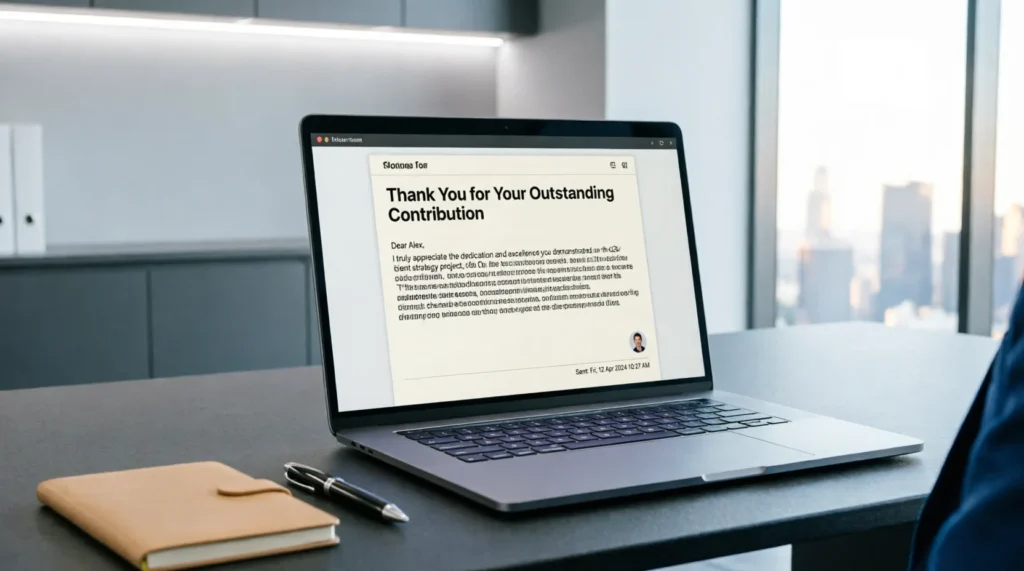
In short, formal responses to work appreciation emails help you acknowledge recognition professionally while strengthening workplace relationships. The best reply shows gratitude, stays genuine, and reflects the tone of your organization without sounding overly scripted. The examples and strategies below will help you find the right words for any situation.
Why Formal Responses to Work Appreciation Emails Feels Tricky
You open your inbox and see an email praising your work. Maybe it’s from your manager, a department head, or a client. Your first reaction is appreciation, but your second reaction is often uncertainty: what exactly should you write back?
That’s why formal responses to work appreciation emails can feel more complicated than they seem. You want to sound grateful without overdoing it. You want to be professional without sounding cold. Most importantly, you want your response to feel authentic.
Many people worry that a short reply may seem dismissive, while a longer response may come across as self-congratulatory. That tension creates hesitation, especially when the praise comes from someone senior.
Communication researchers often note that workplace messages carry both informational and relationship-building value. A simple thank-you email is rarely just a thank-you email. It also communicates professionalism, respect, and emotional intelligence.
When you understand that balance, writing formal responses to work appreciation emails becomes much easier.
What Your Reply Really Communicates
Every response sends signals beyond the words themselves. The tone you choose can influence how your appreciation is received.
A warm thank-you signals confidence, while excessive self-deprecation can sound uncomfortable.
A concise reply signals professionalism, while a one-word response can feel indifferent.
Acknowledging team support signals collaboration, while taking all the credit can feel self-focused.
Expressing appreciation for feedback signals growth, while ignoring the compliment can seem dismissive.
These small choices matter because formal responses to work appreciation emails often become part of your professional reputation. The goal is not simply to reply—it is to reinforce positive working relationships.
10 Best Ways to Reply to Formal Responses to Work Appreciation Emails
Professional and Polished
“Thank you for your kind words. I truly appreciate the recognition and the opportunity to contribute to the team’s success.”
“I appreciate your feedback and support. It was a pleasure working on this project, and I’m grateful for the opportunity.”
“Thank you for taking the time to share your appreciation. Your encouragement means a great deal.”
“I sincerely appreciate your recognition and look forward to continuing to contribute to our goals.”
These responses work well when communicating with senior leadership, executives, or clients. They create a professional impression while maintaining warmth and respect.
Team-Oriented Responses
“Thank you for your thoughtful message. This achievement was truly a team effort, and I’m grateful to have worked alongside such supportive colleagues.”
“I appreciate your recognition. The collaboration and support from the team played a significant role in making this possible.”
“Thank you for your encouragement. I’m fortunate to work with a team that consistently supports shared success.”
“I appreciate your feedback and will be sure to share your kind words with the rest of the team.”
Use these when you want to highlight collaboration. They show humility without minimizing your own contribution.
Grateful and Genuine
“Thank you for your kind email. Your recognition is greatly appreciated and motivates me to continue delivering my best work.”
“I truly appreciate your thoughtful feedback. Knowing that my efforts made a positive impact means a lot.”
“Thank you for your encouragement and support. I’m grateful for the opportunity to contribute and continue learning.”
“Your message was greatly appreciated. Thank you for recognizing my efforts.”
These replies are ideal when the appreciation feels personal or meaningful. They allow you to express sincere gratitude while remaining professional.
Leadership and Management Responses
“Thank you for your thoughtful feedback. Supporting the team and helping achieve our objectives has been incredibly rewarding.”
“I appreciate your recognition and am proud of what we were able to accomplish together.”
“Thank you for your message. The success of this initiative reflects the dedication and commitment of everyone involved.”
“I am grateful for your feedback and remain committed to supporting our team’s continued success.”
These responses work particularly well for managers, supervisors, and team leaders. They acknowledge praise while redirecting attention toward shared outcomes.
The best formal responses to work appreciation emails are not necessarily the longest. They are the ones that feel genuine, appropriate to the relationship, and aligned with the workplace culture.
Tone Matching — Reading the Situation First
Before choosing a response, take a moment to consider the context.
Consider who sent the appreciation email. A reply to a CEO may be more formal than a reply to a close colleague.
Think about the level of recognition. A quick thank-you deserves a simple response, while a detailed note may warrant a more thoughtful reply.
Look at the communication style of the sender. If their message was formal and structured, your response should likely follow a similar tone.
Consider whether others were involved. If the success depended on teamwork, acknowledging colleagues can strengthen relationships.
Etiquette experts often emphasize matching the emotional tone of the original message. The strongest formal responses to work appreciation emails sound professional while still sounding like you.
What NOT to Say When Someone Says Formal Responses to Work Appreciation Emails
“It was nothing.” It sounds humble, but it can accidentally dismiss both your effort and their appreciation.
“Yeah, I know.” Even if it’s a joke, humor does not always translate well in professional email.
“I was actually hoping for a promotion.” Probably not the best time to negotiate.
“The project would have been better if people had listened to me.” Appreciation emails are not performance review responses.
“Thanks.” By itself, it can feel rushed, especially after someone wrote a thoughtful message.
Most mistakes happen because people either downplay the compliment or shift the conversation in an awkward direction. Effective formal responses to work appreciation emails keep the focus on gratitude, professionalism, and positive relationships.
Real-Life Examples — How It Plays Out
Maya received an email from her department director thanking her for leading a successful client presentation. Instead of sending a quick one-line response, she wrote: “Thank you for your kind feedback. I appreciate the opportunity to contribute to the project and work alongside such a talented team.” The director later included her in another high-visibility assignment. Her response reinforced a professional and collaborative image.
David received praise from his manager after completing a difficult project ahead of schedule. Feeling uncomfortable with compliments, he replied with, “Honestly, it wasn’t that hard.” His manager never mentioned it, but the response unintentionally minimized the achievement. Realizing this later, David followed up by thanking his manager for the recognition and expressing appreciation for the team’s support. The conversation quickly returned to a positive note.
FAQs About Formal Responses to Work Appreciation Emails
How do you professionally respond to an appreciation email?
The simplest approach is to thank the sender, acknowledge their feedback, and express appreciation for the opportunity or collaboration. Strong formal responses to work appreciation emails are sincere, concise, and professional.
Should you always reply to a work appreciation email?
In most professional environments, yes. Responding shows respect and acknowledges the effort someone made to recognize your work. Even a brief response is usually better than silence.
How long should formal responses to work appreciation emails be?
Most replies can be completed in two to five sentences. You do not need a lengthy message. The goal is to express gratitude clearly while maintaining professionalism.
Is it okay to mention the team in your response?
Absolutely. If others contributed to the success being recognized, acknowledging them demonstrates leadership and collaboration. Many effective formal responses to work appreciation emails include a brief reference to team support.
What if the appreciation email comes from senior leadership?
A slightly more formal tone is usually appropriate. Thank them for the recognition, acknowledge the opportunity, and reinforce your commitment to contributing to organizational goals.
Final Thoughts
If you searched for formal responses to work appreciation emails, there’s a good chance you wanted to say the right thing without sounding awkward, overly formal, or ungrateful. That’s a completely normal concern because workplace recognition often carries more meaning than a simple compliment. The good news is that a thoughtful, genuine response usually matters far more than finding perfect words. Trust your professionalism, express sincere gratitude, and let your appreciation come through naturally.
If you’re ever unsure in a professional setting, it’s always worth pausing before replying.
Samantha O’Connor is a bestselling author and digital communication expert specializing in smart and flirty exchanges. She graduated with honors in Creative Writing from Boston University and has spent the past 12 years helping individuals and businesses transform their digital presence. Samantha’s fascination with the impact of a well-worded message has driven her to author multiple guides and articles on effective online communication. Her writing is known for its balance of cheeky humor and strategic advice, empowering readers to approach both casual and professional interactions with charm and confidence in the digital age.