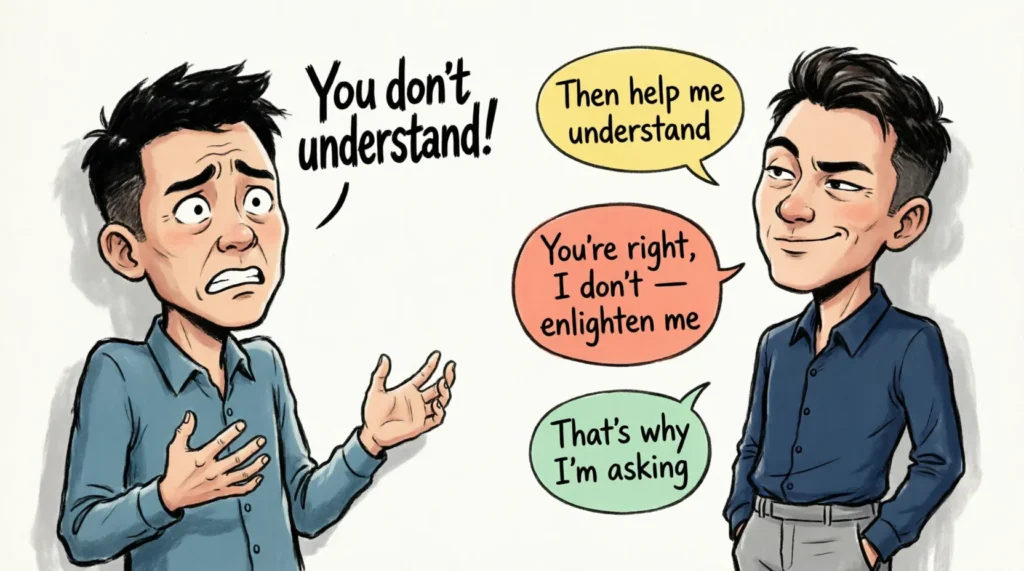
In short, when someone says “you don’t understand,” they’re often expressing frustration, hurt, or a feeling that they haven’t been fully heard. The best response acknowledges their feelings without becoming defensive and helps the conversation move forward instead of turning into an argument. The examples below will help you find the right words for any situation.
Why Best Responses To You Dont Understand Feels Tricky
You’re staring at a text message that says, “You don’t understand.” Maybe it came from a friend, partner, coworker, or family member. Your first instinct might be to defend yourself, explain your side, or fire back with, “Actually, I do.”
That reaction is completely understandable. When someone says you don’t understand, it can feel like they’re dismissing your effort, your empathy, or even your intelligence.
The challenge is that this phrase often carries more emotion than information. Communication researchers have found that people frequently use statements like this when they feel misunderstood, overwhelmed, or emotionally isolated. They’re often asking for connection more than they are making a factual claim.
That’s why finding the best responses to you dont understand matters so much. The right reply can lower tension, while the wrong one can make the conversation spiral into a bigger conflict.
Instead of treating the statement as an attack, it helps to view it as a signal. The person may be telling you that they need more listening, more patience, or simply a different kind of response from you.
What Your Reply Really Communicates
The words you choose after hearing “you don’t understand” can send powerful signals, whether you mean to or not.
“Help me understand” sounds open and confident.
“Yes, I do” can sound dismissive even when you mean well.
“Tell me more about what I’m missing” feels supportive and curious.
“Whatever” usually signals frustration and shuts the conversation down.
The best responses to you dont understand aren’t necessarily the smartest or most clever. They’re the ones that make the other person feel heard while still respecting your own perspective.
10 Best Ways to Reply to You Dont Understand
Calm and Understanding Replies
“You’re right, I might not fully understand. Can you explain it to me?”
“I want to understand. Tell me what I’m missing.”
“Maybe I don’t see it the way you do yet, but I’m listening.”
“Help me see this from your perspective.”
These responses work well when emotions are running high. They show maturity and a willingness to listen without automatically admitting fault.
Confident but Respectful Replies
“I understand some of it, but maybe not all of it.”
“That’s possible. What part do you feel I’m not understanding?”
“I’m trying my best to understand your point.”
“Let’s talk through it so we’re on the same page.”
Use these when you want to stay calm while also maintaining your own position. They communicate confidence without becoming argumentative.
Thoughtful and Empathetic Replies
“It sounds like you’re feeling really frustrated.”
“I can tell this means a lot to you.”
“Even if I don’t fully understand, I care about what you’re saying.”
“I may not have lived your experience, but I’m listening.”
Social psychologists often note that people want emotional validation before logical solutions. These replies help create that sense of understanding.
Witty but Friendly Replies
“You’re probably right—I left my mind-reading powers at home.”
“Then give me the director’s commentary version.”
“Okay, catch me up. I don’t want to miss the plot.”
“Fair enough. Help me unlock the next level.”
These lighter responses work best with friends or people who appreciate humor. They can ease tension while still inviting conversation.
Tone Matching — Reading the Situation First
Before choosing from these best responses to you dont understand, take a moment to assess the situation.
Consider your relationship with the person. A romantic partner may need empathy, while a coworker may appreciate clarity.
Think about the emotional intensity. If the person sounds hurt, a gentle response usually works better than a witty one.
Look at the context. A text message leaves room for misunderstanding, while an in-person conversation gives you tone and body language.
Ask yourself whether they want understanding or agreement. Sometimes people only want to feel heard, not necessarily validated on every point.
The strongest response is usually the one that sounds natural coming from you. Authenticity matters more than finding a perfect script.
What NOT to Say When Someone Says You Dont Understand
“Actually, I understand better than you think.” This often sounds more defensive than helpful.
“You’re being dramatic.” Nothing accelerates an argument quite like dismissing someone’s feelings.
“Whatever.” The conversational equivalent of slamming a door.
“That’s your problem, not mine.” Technically possible, socially disastrous.
“Calm down.” Few phrases in human history have been less effective at helping people calm down.
Most mistakes happen because people focus on defending themselves instead of understanding the emotion behind the statement. The goal isn’t to win a debate. The goal is to keep communication open long enough for both sides to feel heard.
Real-Life Examples — How It Plays Out
Emma and her sister were discussing family responsibilities. During the conversation, her sister suddenly said, “You don’t understand how much pressure I’m under.” Emma resisted the urge to argue and replied, “You’re right, maybe I don’t fully understand. Tell me more about what’s been weighing on you.” The conversation immediately softened, and they ended up having one of their most honest discussions in months.
Jake was texting his girlfriend after a stressful day. She wrote, “You don’t understand what today was like for me.” Jake quickly replied, “Of course I understand.” The response frustrated her even more because she felt dismissed. Realizing his mistake, he followed up with, “Sorry, that came out wrong. I want to understand. What happened?” The conversation recovered because he shifted from defending himself to listening.
FAQs About Best Responses To You Dont Understand
What is the best response when someone says you don’t understand?
A strong response is, “You’re right, I might not fully understand. Can you help me understand?” This acknowledges their feelings while inviting deeper conversation. Many of the best responses to you dont understand follow this approach.
Should I apologize when someone says you don’t understand?
Not always. If you’ve genuinely misunderstood something, an apology can help. If not, simply showing curiosity and willingness to listen may be enough.
Is “maybe you’re right” a good response?
Yes, in many situations. It lowers defensiveness and shows humility without requiring you to completely abandon your own perspective.
How do I respond without sounding defensive?
Focus on asking questions instead of proving your point. Responses like “What am I missing?” or “Can you tell me more?” tend to keep conversations productive.
What if someone says I don’t understand during an argument?
Slow the conversation down. The best responses to you dont understand during conflict acknowledge emotion first and facts second. People are often more willing to discuss solutions once they feel heard.
Final Thoughts
Searching for the best responses to you dont understand usually means you’re trying to navigate a difficult moment without making it worse. Whether the comment comes from a friend, partner, family member, or coworker, the key is remembering that the statement is often more about feeling unheard than proving a point.
You don’t have to agree with everything someone says to respond well. Often, simply showing curiosity, patience, and respect is enough to change the direction of the conversation. The next time you hear “you don’t understand,” remember that a thoughtful reply can turn a frustrating moment into a meaningful connection.
Frequently Asked Questions
What does it mean when someone says 'you don't understand'?▼
When someone says ‘you don’t understand,’ they are often expressing feelings of frustration or emotional isolation. This statement usually signals a need for connection rather than a factual claim, indicating that they feel unheard.
How should I respond if someone tells me I don't understand?▼
The best response is to acknowledge their feelings without being defensive. Phrases like ‘Help me understand’ or ‘Can you explain it to me?’ show that you are willing to listen and engage in a constructive conversation.
What are some calm and understanding replies to use?▼
Effective calm and understanding replies include ‘You’re right, I might not fully understand. Can you explain it to me?’ or ‘Help me see this from your perspective.’ These responses demonstrate maturity and a willingness to listen.
Can humor be effective in responding to 'you don't understand'?▼
Yes, witty but friendly replies can alleviate tension when speaking with friends or those who appreciate humor. Responses like ‘You’re probably right—I left my mind-reading powers at home’ can invite conversation while keeping the mood light.
How can I maintain my own perspective while responding?▼
Using confident but respectful replies such as ‘I understand some of it, but maybe not all of it’ allows you to express your viewpoint without escalating the conflict. This approach communicates that you are engaged while also respecting your own perspective.
Why is it important to find the right response to 'you don't understand'?▼
Finding the right response is crucial because it can lower tension in the conversation and prevent it from escalating into a bigger conflict. A thoughtful reply can foster better communication and understanding between both parties.
What role does emotional validation play in these responses?▼
Emotional validation is key as it helps create a sense of understanding before logical solutions are discussed. Replies that acknowledge the other person’s feelings, such as ‘I can tell this means a lot to you,’ can help establish a supportive dialogue.
Carlos is a conversation strategist and lead writer at FlirtyResponse.com, where he focuses on helping people craft confident, witty, and effective replies in real-life social and dating situations. He specializes in turning awkward moments, dry texts, and missed opportunities into smooth, engaging conversations that actually get responses.
Instead of overanalyzing emotions or relying on cheesy pickup lines, Carlos approaches flirting as a skill — one that can be learned, practiced, and improved. He breaks down what works, what doesn’t, and why, giving readers clear, usable responses they can apply instantly.
He pays close attention to tone, timing, and context — the small details that make the difference between being ignored and getting a reply. From playful comebacks and teasing responses to confident replies in tricky situations, Carlos helps readers handle conversations without overthinking.
At FlirtyResponse.com, his mission is simple: make communication easier, smoother, and more effective. He doesn’t just give lines — he helps readers understand how to respond naturally, build attraction, and keep conversations going without forcing it.