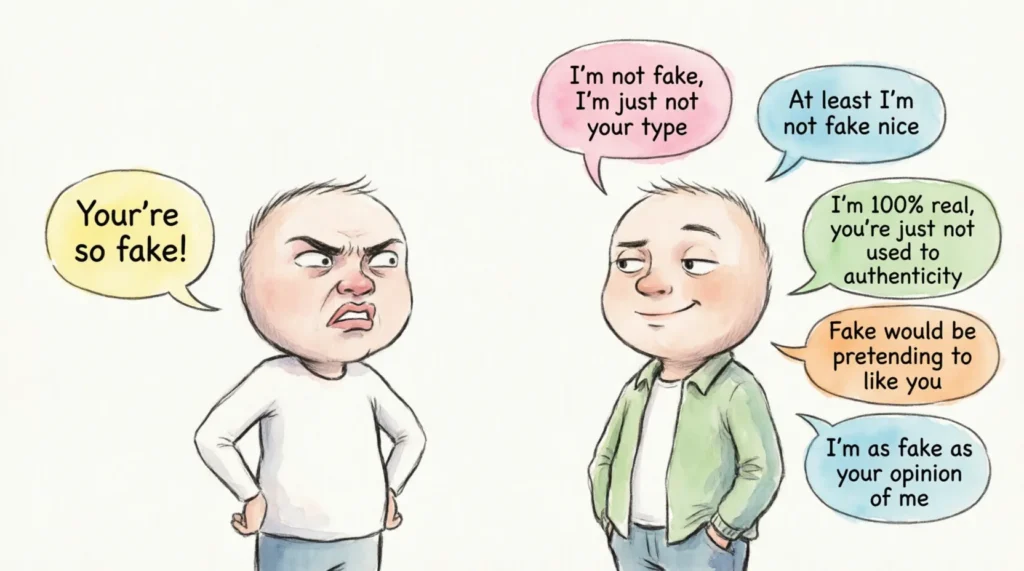
In short, the best comebacks when someone calls you fake are calm, confident, and tailored to the situation. Instead of reacting emotionally, you can respond with humor, curiosity, or self-assurance that protects your dignity and keeps the conversation under your control. The examples below will help you find the right words when you’re put on the spot.
Why Best Comebacks When Someone Calls You Fake Feels Tricky
You’re standing with friends, scrolling through comments, or reading a text when someone suddenly says, “You’re fake.” Your stomach drops for a second, and your mind races through a hundred responses.
The problem is that accusations like this hit close to home. Most people want to be seen as genuine, so being called fake can feel like a direct attack on your character.
That’s why many people search for the best comebacks when someone calls you fake. You want to defend yourself, but you don’t want to sound angry, insecure, or overly dramatic.
Communication researchers often note that personal accusations trigger emotional reactions because they challenge how we see ourselves. The trick isn’t proving yourself in the moment—it’s responding in a way that shows confidence and self-respect.
When you stay calm, you immediately put yourself in a stronger position. A thoughtful comeback often says more than a heated argument ever could.
What Your Reply Really Communicates
The words you choose after being called fake send a message about your confidence level.
“Can you explain what you mean?” sounds composed and mature.
“Whatever you say” can sound dismissive or defensive.
“You’re entitled to your opinion” signals confidence without aggression.
“No, you are!” usually sounds like an elementary school debate.
The best comebacks when someone calls you fake aren’t always the sharpest. Often, they’re the ones that show you’re secure enough not to let the accusation shake you.
10 Best Ways to Reply to Someone Calling You Fake
Calm and Confident Comebacks
“That’s your opinion, and you’re welcome to it.”
“I know who I am, and that’s enough for me.”
“You don’t have to understand me to have an opinion about me.”
“Interesting. What makes you think that?”
These responses work because they stay composed. Instead of escalating the situation, they show that you’re comfortable in your own skin.
Clever and Witty Comebacks
“If I were fake, I’d probably have a better personality upgrade.”
“That’s funny coming from someone who barely knows me.”
“I must be a pretty convincing original then.”
“Good thing my self-worth isn’t based on customer reviews.”
Humor can be powerful when used correctly. Social psychologists often note that light humor can reduce tension while demonstrating confidence.
Direct and Assertive Comebacks
“I’d rather be misunderstood than pretend to be someone I’m not.”
“Just because I don’t act the way you expect doesn’t make me fake.”
“You can disagree with me without labeling me.”
“I’m not responsible for the version of me you’ve created in your head.”
These replies work well when someone is being confrontational. They set boundaries without becoming unnecessarily hostile.
Playful and Casual Comebacks
“Fake? I can barely keep up with being myself.”
“Trust me, if this were an act, I’d have memorized my lines better.”
“I wish I were fake. Maybe then I’d be more organized.”
“That’s one theory. Got any others?”
These responses keep the mood lighter while still standing up for yourself. They’re especially useful when the accusation isn’t particularly serious.
Tone Matching — Reading the Situation First
Before choosing among the best comebacks when someone calls you fake, take a moment to assess what’s really happening.
Consider who is saying it. A close friend may be expressing frustration, while a stranger may simply be trying to provoke you.
Pay attention to the setting. A public confrontation often benefits from a calm response rather than a dramatic one.
Think about the intent behind the comment. Was it teasing, criticism, or an attempt to start an argument?
Ask yourself whether a response is even necessary. Sometimes the strongest comeback is refusing to engage.
The best comeback when someone calls you fake is often the one that protects your peace while preserving your confidence.
What NOT to Say When Someone Calls You Fake
“No, you’re fake!” The classic reverse-card strategy rarely impresses anyone.
“Everybody hates you anyway.” Escalation is not the same thing as confidence.
“I’m not fake, I swear!” Over-explaining can accidentally make you sound insecure.
“You’re just jealous.” Sometimes true, but almost never persuasive.
Writing a five-paragraph defense speech in the group chat. This is a conversation, not a courtroom.
Most mistakes happen because people react emotionally instead of intentionally. The goal isn’t to win every argument. It’s to respond in a way that reflects who you are rather than who the other person says you are.
Real-Life Examples — How It Plays Out
Sophia was chatting with classmates when someone joked, “You’re so fake.” Instead of getting upset, she smiled and replied, “That’s interesting. What exactly am I faking?” The person stumbled through an explanation and quickly realized they didn’t have much substance behind the accusation. The conversation moved on, and Sophia came across as calm and confident.
Meanwhile, Jordan received a message from an acquaintance saying, “You’re fake.” Frustrated, he immediately fired back with several angry texts. The exchange became a long argument that left both people annoyed. Later, Jordan realized he could have simply replied, “You’re entitled to your opinion,” and saved himself the stress.
FAQs About Best Comebacks When Someone Calls You Fake
What is the best comeback when someone calls you fake?
One of the strongest responses is, “What makes you think that?” It shifts the focus back to the other person and invites them to explain their claim rather than forcing you to defend yourself.
Should I argue if someone calls me fake?
Usually, no. Many of the best comebacks when someone calls you fake work because they avoid unnecessary arguments. Calm confidence often has more impact than a lengthy debate.
How do I respond without sounding defensive?
Keep your tone neutral and avoid over-explaining. Responses like “That’s your opinion” or “I know who I am” communicate confidence without inviting conflict.
What if a friend calls me fake?
If the friendship matters, consider asking questions instead of immediately getting defensive. Sometimes people use the word “fake” when they’re actually feeling hurt, confused, or disconnected.
Are funny comebacks a good idea?
They can be, especially if the situation isn’t overly serious. Some of the best comebacks when someone calls you fake use humor to show confidence while keeping the atmosphere relaxed.
Final Thoughts
Searching for the best comebacks when someone calls you fake usually means you’re trying to protect your reputation without losing your composure. That’s a smart goal because how you respond often matters more than the accusation itself.
You don’t need the perfect one-liner to prove your authenticity. A calm, confident response often speaks louder than a dramatic comeback ever could. Trust yourself, stay grounded, and remember that people who truly know you rarely need convincing about who you are.
Frequently Asked Questions
What are some calm and confident comebacks I can use when someone calls me fake?▼
You can respond with phrases like, ‘That’s your opinion, and you’re welcome to it,’ or ‘I know who I am, and that’s enough for me.’ These replies show that you are composed and secure in your identity.
How can humor be effectively used in responses to accusations of being fake?▼
Using humor can diffuse tension and demonstrate confidence. For instance, you might say, ‘If I were fake, I’d probably have a better personality upgrade,’ which keeps the conversation light while asserting your self-worth.
What should I consider before responding to someone who calls me fake?▼
It’s important to assess the situation and the relationship with the person making the accusation. Understanding their intent and your emotional response can help you choose the most appropriate comeback.
What are some direct and assertive comebacks to use in a confrontational situation?▼
Replies like, ‘I’d rather be misunderstood than pretend to be someone I’m not,’ or ‘Just because I don’t act the way you expect doesn’t make me fake,’ effectively set boundaries while maintaining your dignity.
Why is it important to respond calmly when accused of being fake?▼
Responding calmly allows you to maintain control over the conversation and demonstrates confidence. It prevents the situation from escalating and reflects self-respect.
Can you give examples of playful and casual comebacks for accusations of being fake?▼
You might say, ‘Fake? I can barely keep up with being myself,’ or ‘Trust me, if this were an act, I’d have memorized my lines better.’ These types of responses can lighten the mood while still defending your authenticity.
What is the significance of tailoring your response to the situation when someone calls you fake?▼
Tailoring your response helps you connect with the person and the context, allowing for a more effective reply. It shows that you are aware of the dynamics at play and can respond in a way that fits the moment.
Samantha O’Connor is a bestselling author and digital communication expert specializing in smart and flirty exchanges. She graduated with honors in Creative Writing from Boston University and has spent the past 12 years helping individuals and businesses transform their digital presence. Samantha’s fascination with the impact of a well-worded message has driven her to author multiple guides and articles on effective online communication. Her writing is known for its balance of cheeky humor and strategic advice, empowering readers to approach both casual and professional interactions with charm and confidence in the digital age.