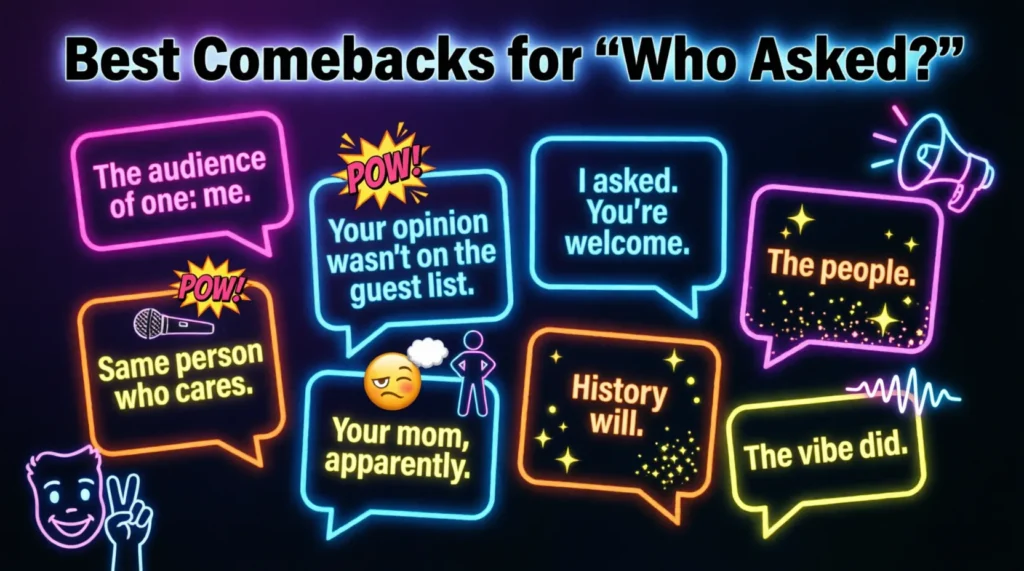
In short, the best comebacks for who asked are confident, funny, and lighthearted replies that keep you in control without sounding overly defensive. Whether you’re dealing with playful teasing or an annoying interruption, the right response can turn an awkward moment into a clever one. Below, you’ll find ready-to-use comebacks for every situation and personality type.
Why Best Comebacks for Who Asked Feels Tricky
You’re in the middle of telling a story, sharing an opinion, or making a joke. Then someone drops the classic line: “Who asked?” Suddenly, you’re staring at your screen or standing there wondering whether to laugh it off, ignore it, or fire back with something clever.
That’s exactly why people search for best comebacks for who asked. The phrase itself is designed to dismiss what you just said, often with a hint of sarcasm. Even when it’s meant jokingly, it can make you feel put on the spot.
The challenge isn’t just finding a comeback. It’s finding one that protects your confidence without making you look overly bothered. Communication researchers often note that people respond best when they project calm confidence rather than visible frustration.
A strong reply shows that you can handle the moment without losing your cool. That’s what makes the difference between a memorable comeback and an awkward argument.
What Your Reply Really Communicates
When someone says “Who asked?”, your response sends a message beyond the words themselves.
A playful response signals confidence and social awareness.
A witty response shows quick thinking without sounding angry.
An aggressive response can make it seem like the comment got under your skin.
A completely defensive response often gives the other person exactly the reaction they wanted.
The goal isn’t necessarily to win. It’s to show that you’re comfortable enough to keep the conversation moving on your terms. That’s why the best comebacks for who asked balance humor, confidence, and timing.
10 Best Ways to Reply to Who Asked
Funny Comebacks
“Apparently you did, since you’re still listening.”
“The same person who asked for your opinion.”
“Nobody. I was feeling generous.”
“Don’t worry, attendance wasn’t mandatory.”
These work best when the situation is light and playful. Humor helps you avoid looking defensive while still landing a clever response.
Witty Comebacks
“I wasn’t aware applications were required.”
“Interesting. I don’t remember taking questions either.”
“Good thing sharing information isn’t invite-only.”
“I must’ve missed the part where permission was needed.”
Use witty replies when you want to sound sharp and confident. They work especially well in group conversations where timing matters.
Playful Comebacks
“Your curiosity gave you away.”
“You stayed long enough to hear it.”
“You seem surprisingly invested.”
“Yet here we are discussing it.”
Playful responses keep the energy friendly while reminding the other person that they’re still engaged in the conversation.
Bold Comebacks
“Nobody asked. I volunteered.”
“I don’t wait for invitations.”
“The world keeps turning anyway.”
“Not every announcement requires approval.”
These are stronger responses for situations where someone is intentionally trying to be dismissive. They project confidence without becoming outright hostile.
Casual Comebacks
“Fair enough. Anyway…”
“Good question. Moving on.”
“Probably nobody, but now everyone knows.”
“Just thought I’d share.”
Sometimes the smartest move is not escalating at all. Casual replies can make the original comment lose its impact almost instantly.
When choosing among these options, remember that delivery matters as much as the words themselves. A calm smile often lands better than the perfect line delivered angrily.
Tone Matching — Reading the Situation First
Before using any comeback, take a second to understand the context.
Is the person joking or genuinely trying to dismiss you? A playful friend deserves a different response than someone trying to embarrass you.
Are you talking online or face-to-face? Text-based humor can sometimes sound harsher than intended.
Is this a close friend, classmate, coworker, or stranger? Your relationship should shape how bold your reply becomes.
What was the mood before the comment? If everyone was joking around, a light comeback usually works best.
The best comebacks for who asked aren’t always the sharpest ones. They’re the ones that fit the situation and still sound like something you would naturally say.
What NOT to Say When Someone Says Who Asked
“Why are you always so rude?” when everyone else is clearly joking.
Writing a paragraph-long defense of why your comment mattered.
Instantly insulting the person’s appearance or intelligence.
Pretending you’re not bothered while obviously sounding furious.
Turning a harmless joke into a full-scale debate worthy of a courtroom drama.
Most mistakes happen because people focus on proving themselves right rather than managing the interaction. When responding to best comebacks for who asked situations, confidence usually beats aggression.
The less emotional energy you give the comment, the stronger your position tends to look.
Real-Life Examples — How It Plays Out
Maya was sharing a funny story in a group chat when a friend typed, “Who asked?” Instead of getting annoyed, she replied, “Apparently someone interested enough to read this far.” The group immediately reacted with laughing emojis. The moment stayed playful, and the conversation continued naturally.
Jake was talking during lunch when a classmate interrupted with, “Who asked?” Feeling embarrassed, he snapped back with a personal insult. The mood became uncomfortable, and several people went quiet. Later, he realized a simple response like “Nobody. I was just talking.” would have worked much better.
These examples show that a good comeback isn’t just about being clever. It’s about controlling the tone of the interaction.
FAQs About Best Comebacks for Who Asked
What is the best comeback for who asked?
The best comeback for who asked depends on the situation, but simple replies like “Nobody. I volunteered.” or “Interesting, I don’t remember asking either.” are popular because they’re confident without sounding overly angry.
Is “Who asked?” always rude?
Not necessarily. Sometimes friends use it jokingly as part of playful banter. The tone, relationship, and context matter more than the words alone.
Should I ignore someone who says “Who asked?”
Sometimes yes. If the person is clearly looking for a reaction, ignoring the comment can be surprisingly effective. Not every remark deserves a comeback.
How do I respond without sounding rude?
Use humor, confidence, or light sarcasm rather than direct insults. The strongest replies often sound effortless instead of aggressive.
Why do people say “Who asked?”
People usually say it to tease, challenge, or dismiss a statement. In some friend groups it’s playful banter, while in other situations it’s meant to undermine the speaker. Understanding that difference helps you choose the right response.
Final Thoughts
Searching for best comebacks for who asked usually means you wanted the perfect response for a moment that caught you off guard. Maybe someone interrupted your story, challenged your opinion, or tried to get a reaction out of you. The good news is that you don’t need a devastating one-liner to handle it well.
The strongest responses are usually calm, witty, and authentic to your personality. Whether you choose humor, confidence, or simply move on, your goal isn’t to win an argument—it’s to stay comfortable in your own voice. The next time someone asks “Who asked?”, you’ll have plenty of clever options ready before they finish the sentence.
Frequently Asked Questions
What are some confident comebacks for the phrase 'Who asked?'▼
Confident comebacks include witty responses like ‘Nobody asked. I volunteered.’ or ‘I don’t wait for invitations.’ These replies assert your presence and opinion without appearing defensive.
How can humor be used effectively in comebacks?▼
Using humor can lighten the mood and prevent you from seeming overly bothered. Responses like ‘Apparently you did, since you’re still listening.’ are playful and keep the conversation engaging.
What should I consider before using a comeback?▼
It’s important to read the situation and assess whether the other person is joking or genuinely trying to dismiss you. A playful or witty response works best in lighthearted scenarios, while bold comebacks may be more appropriate for dismissive comments.
What tone should I use when delivering a comeback?▼
Delivery is crucial; a calm smile often works better than the perfect line said angrily. Aim for a tone that conveys confidence and ease, allowing you to maintain control of the conversation.
Are there specific comebacks for group conversations?▼
Yes, witty comebacks like ‘Interesting. I don’t remember taking questions either.’ are effective in group settings. They showcase your confidence and quick thinking while engaging everyone present.
What are casual comebacks and when should I use them?▼
Casual comebacks like ‘Fair enough. Anyway…’ can defuse tension and make the original comment feel less significant. Use these when you want to move on without escalating the conversation.
How do I balance humor and confidence in my responses?▼
The best comebacks strike a balance by being humorous while still projecting confidence. For instance, using a playful reply like ‘You stayed long enough to hear it.’ can keep the tone light while asserting your presence.
Jenna Nguyen is an award-winning writer with a particular interest in the evolving dynamics of digital communication. With a degree in Creative Writing from the University of British Columbia, she has spent the past decade helping brands and individuals refine their voice online. Jenna’s extensive experience includes crafting clever comebacks and flirty exchanges that resonate with diverse audiences. Her unique approach combines a playful tone with insightful guidance, ensuring that her readers can tackle even the most challenging conversational scenarios with ease. Jenna is committed to fostering authentic and impactful interactions in an age dominated by screens.